Join my email list to get the best and latest info for basketball coaches.
Stop Losing Winnable Games: How Roy Weathers and Anova Sports Are Bringing the “Moneyball” Revolution to Basketball
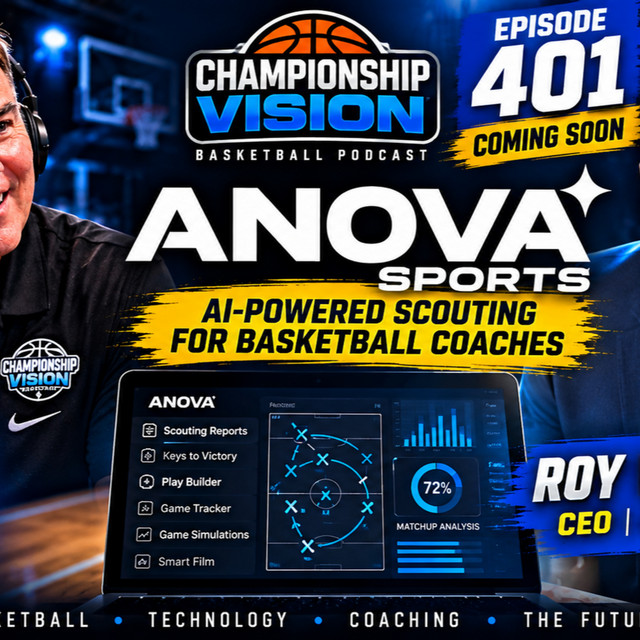
Stop Losing Winnable Games: How Roy Weathers and Anova Sports Are Bringing the “Moneyball” Revolution to BasketballChampionship Vision Basketball Podcast — Episode 401Featuring Roy Weathers, Co-Founder of Anova Sports For decades, basketball coaches have searched for an edge. They watch hours of film. They exchange scouting reports. They chart possessions. They study tendencies, shooting percentages, turnovers and rebounding numbers. Then, after collecting all that information, they still have to answer the question that matters most: What do we actually need to do to win this game? Roy Weathers believes artificial intelligence can help coaches answer that question. On Episode 401 of the Championship Vision Basketball Podcast, I sat down with Weathers, co-founder of Anova Sports, for a fascinating conversation—and live demonstration—about what may be the next major evolution in basketball scouting. Anova isn't simply trying to give coaches more data. It's trying to help coaches make better decisions with the data they already have. And perhaps most importantly, Weathers wants to make technology that has traditionally been associated with elite programs accessible to high-school coaches across the country. The Inspiration: Basketball Meets MoneyballWeathers' connection to basketball goes well beyond technology. His brother played Division I basketball at the University of Richmond, and his son plays Division III basketball at Wesleyan University in Connecticut. Weathers described basketball as something that has been part of his life since childhood. Professionally, Weathers spent years in the corporate world at PwC, building a career around statistics and information. As artificial intelligence began developing rapidly, he and his team started asking a simple question: How can we use these tools to make a coach's life better? Two needs immediately stood out: help coaches win more games and help them save time. The philosophy behind Anova also has roots in Moneyball. Weathers sees basketball facing a problem similar to the one baseball confronted: everyone has information, but information alone isn't necessarily an advantage. “The challenge isn't a lack of information. It's knowing what matters most and how to act on it.” That's the idea behind Anova. It combines analytics, predictive modeling and simulations to move beyond simply telling a coach what happened. It attempts to answer: What is most likely to happen next—and what can we do about it? From Box Scores to a Game PlanOne of the most impressive parts of our conversation came when Roy shared his screen and took Championship Vision viewers directly inside the Anova platform. Anova starts with something almost every high-school program can access: box-score data. That decision was intentional. As Weathers explained, most high schools don't have the wearables, multiple-camera systems and sophisticated resources available at the highest levels of college basketball or the NBA. Anova therefore built its approach around information that is much more readily available to coaches. Coaches can import information in several ways, including PDF, CSV and Excel files, manually entered information, Anova's Smart Film feature and certain data available through its database. But collecting the data is only the beginning. What If You Could Play the Game 1,000 Times Before Tipoff?This is where Anova becomes particularly interesting. The platform uses simulation modeling to run a matchup roughly 1,000 times. In the demonstration, Weathers used UConn and Michigan. Based on the data entered into the system, Anova simulated the matchup repeatedly and calculated UConn's probability of a positive outcome. But the winning percentage isn't really the breakthrough. The important question is: Why? Why did one team win more simulations than another? And more importantly: What could the coach change to increase the probability of winning? That's where Anova attempts to uncover the competitive edge. Six Keys to VictoryAnova analyzes the simulations and identifies six variables that could potentially improve a team's likelihood of winning. This may be the most powerful part of the system for coaches. Instead of telling players something broad like: “We have to rebound tonight.” Anova can provide a specific target. In Roy's demonstration, for example, the model identified particular rebounding numbers that UConn needed to reach while simultaneously limiting Michigan's rebounds. When one of those objectives was removed from the model, the projected winning probability changed by roughly five percentage points. Pasted text That changes the conversation with players. Instead of: “Rebound harder.” It becomes: “We need 38 rebounds tonight.” Instead of: “Take care of the basketball.” It becomes: “We cannot have more than eight turnovers.” Now the players have a scoreboard within the scoreboard. Weathers shared a great example from a high-school coach who began sharing these goals with his players. Players who had barely been rebounding suddenly became what the coach jokingly described as “mini Dennis Rodmans” because they were chasing a concrete number together. As a coach, this immediately caught my attention. For years, I have used standards and statistical goals with my teams. But Anova potentially makes those standards opponent-specific rather than generic. That's a major distinction. “It's Not Magic. It's Math.”One of my favorite lines from Roy during the interview came when he discussed Anova's ability to anticipate game situations. “It's not magic. It's math.” If the computer can observe approximately 1,000 versions of the same matchup, it can identify situations that appear repeatedly and bring those scenarios to the coach before the real game ever begins. The purpose isn't to predict every possession. It's to help the coach think through potential situations before being forced to make the decision under pressure during the game. That is where AI becomes much more interesting to me as a coach. AI Doesn't Replace the CoachThis was one of the most important points of the entire conversation. Weathers repeatedly emphasized that Anova isn't designed to replace a good basketball coach. Instead, he described the division of responsibility this way: Anova can help with the WHAT and the WHY. The coach still has to determine the HOW. That's exactly right. A computer might tell me that getting 12 offensive rebounds significantly increases our probability of winning. But the computer isn't standing in my practice. I still have to determine: How are we going to get those rebounds? Who are we sending to the glass? What drills do we need? How do we teach our players? How do I convince a 16-year-old that this possession matters? That's coaching. And no algorithm eliminates that responsibility. Smart Film: Watch What MattersAnova's Smart Film feature may be especially valuable to high-school coaches. Weathers explained that the company learned there are thousands of schools without sophisticated film-processing capabilities. That led Anova to develop technology using computer vision rather than relying exclusively on people manually tagging film. Pasted text The system can identify and organize offensive actions, including what occurred before a made basket. It can also group similar actions together. That means instead of watching an entire game hoping to discover a pattern, a coach can potentially filter the film to the actions an opponent runs most frequently and study those possessions. The objective again comes back to one precious commodity: TIME. “I Got My Sundays Back.”For me, this might have been the most powerful testimonial Roy shared. One coach who had used Anova extensively told him: “I got my Sundays back.” The coach wasn't saying he stopped preparing. He was saying that once he became comfortable with the system, he could spend more time on the floor with his players and less time buried in scouting information. He could also spend part of Sunday with his family instead of giving another entire day to film and data. High-school coaches understand exactly what that means. Many of us teach all day, practice in the afternoon, play at night, travel home late and then start preparing for the next opponent. Technology becomes valuable when it doesn't simply give us more information. It gives us time back. The Ultimate Test: Can Analytics Help Win a Game You Shouldn't Win?Weathers shared one story that captures the entire Anova philosophy. A coach entered a matchup in which the model initially gave his team only about a 30% probability of winning. After examining Anova's six Keys to Victory, the coach focused his practices around those specific objectives and shared them with his players. They followed the plan. The game went to overtime. And they won. According to Weathers, the coach received roughly 100 messages afterward because people couldn't believe his team had beaten that opponent. That's Moneyball. Not replacing coaching. Not pretending talent doesn't matter. Not guaranteeing victory. It's about finding a few percentage points that might otherwise remain hidden—and giving your players the best possible chance to succeed. The Future Is Coming QuicklyI asked Roy to finish this sentence: “Five years from now, AI in basketball will be…” His answer was simple: “Prolific.” Weathers believes AI will eventually become like film is today—something essentially everyone uses. His argument is that the real opportunity exists between now and then. There was once a time when simply having access to game film provided a competitive advantage. Eventually everybody gained access. Predictive analytics may follow the same path. That raises an important question for coaches: Do you wait until everyone else is using the technology—or start learning how to use it now? The Human Element Still WinsNear the end of our conversation, I made a statement to Roy that I believe strongly: There is no AI for great teachers and great coaches. He agreed. Technology can analyze. It can calculate. It can simulate. It can identify patterns faster than we can. But it can't build the relationship with the player. It can't walk into the locker room at halftime and understand the emotional temperature of the team. It can't know exactly when a struggling young player needs encouragement—or when that same player needs to be challenged. And it can't replace the ability of a great coach to take information and teach players how to execute it. Weathers described that human component as the “magic of coaching.” That's why I came away from this conversation believing the most interesting question isn't: Will AI replace basketball coaches?It's: What happens when great coaches learn how to use AI?That may be where the real competitive advantage lies. About Roy Weathers & Anova SportsRoy Weathers is co-founder of Anova Sports, an AI-powered basketball platform focused on scouting, predictive analytics, simulations, Smart Film, game tracking and helping coaches translate information into actionable decisions. His mission is straightforward: make sophisticated analytical tools available to coaches who historically haven't had access to them—particularly at the high-school level. And his message to coaches may be even simpler: Stop losing winnable games.Learn more at Anova Sports. Championship Vision Basketball Podcast — Episode 401
Thanks, Coach Kevin Furtado |
Championship Vision Podcast
Join my email list to get the best and latest info for basketball coaches.
ALL IN OR AVERAGE How Hall of Fame Coach Kevin Orr Builds Culture, Connection and the Squid Defense By Coach Kevin Furtado | Championship Vision Podcast What separates a good basketball program from one that players remember for the rest of their lives? For Wisconsin Basketball Coaches Association Hall of Fame coach Kevin Orr, the answer begins long before you start talking about offense, defense or winning championships. It begins with relationships. During our conversation on the...
🏀 Championship Vision Basketball Newsletter The 10th Annual Legends On-Court Clinic Series Is Almost Here! Dear Coach, The basketball season is just around the corner, and there is no better time to invest in yourself and your program than by learning from some of the best coaches in the Southeast. On Saturday, October 3, 2026, we will celebrate the 10th Annual Championship Vision Legends On-Court Clinic Series at Calvary Day School in Savannah, Georgia. Over the past decade, the Legends...
Elevate Above the Rest: Inside Tyler Whitcomb’s Elevation Offense By Coach Kevin Furtado Championship Vision Basketball Podcast – Episode 396 Basketball coaches are constantly searching for an advantage. Sometimes that advantage isn't another set play. It isn't copying what the latest college program is running. The advantage can come from finding an offensive system that fits your personnel, forces the defense to make decisions, and then gives your players the freedom to read those...