Join my email list to get the best and latest info for basketball coaches.
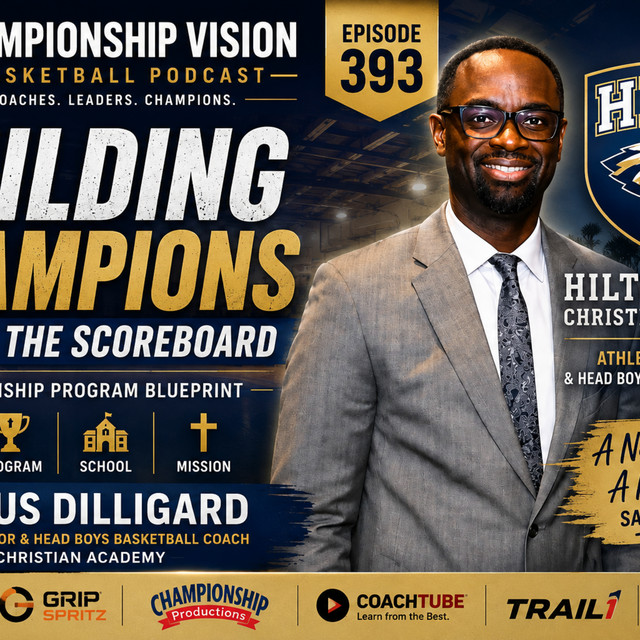
"Building More Than a Team"- with Coach Marcus Dillard- Athletic Director at Hilton Head Christian Academy
Building More Than a Team: Marcus Dilligard’s Vision for Hilton Head Christian AcademyEpisode 393 of the Championship Vision Basketball PodcastBy Coach Kevin Furtado There is a difference between coaching a team and building a program. A team can have a successful season. A program can win a championship. But a true program builder creates something that continues long after the final buzzer—and perhaps even after the coach has moved on. That was one of the biggest messages I took away from my conversation with Coach Marcus Dilligard, the newly hired athletic director and varsity boys basketball coach at Hilton Head Christian Academy. Coach Dilligard brings an impressive background to the Lowcountry. He played college basketball at Furman University before continuing his career professionally in South America. His coaching and administrative journey has included Victory Christian Center School, the University of the Cumberlands, and Grace Christian Academy in Knoxville. Along the way, his résumé has included championship success, nationally ranked teams and players, and more than 45 players who have gone on to play college basketball. But what interested me most wasn't the résumé. It was the vision behind it. The Program Is Bigger Than the PlayerEarly in our conversation, Coach Dilligard shared the philosophy that sits at the foundation of everything he wants to build: No player is bigger than the team. No team is bigger than the program. No program is bigger than the school. And the school is not bigger than the mission. That is more than a basketball quote. It is a blueprint for leadership. Too often, coaches become consumed with building the varsity team. We worry about this year's starting five, this year's schedule and this year's postseason. Program builders think differently. They think about the elementary school player who may not put on a varsity uniform for another eight years. They think about the middle school coach. They think about developing future leaders. They think about what happens when the current senior class graduates. And most importantly, they think about whether the program represents the mission of the school. That's where Coach Dilligard's vision becomes especially powerful. Build the Program From the Bottom UpOne of my favorite parts of our conversation centered on feeder programs. This is something I believe strongly in: Championship programs don't begin in ninth grade. Coach Dilligard believes the foundation starts at the elementary level by teaching fundamentals while keeping basketball fun. Ball handling, passing and footwork still matter. Those things haven't changed. But his vision goes beyond basketball instruction. He wants varsity athletes involved with younger students, including reading to elementary children and becoming visible examples of what the program represents. As players move into middle school, the expectations gradually increase—more competitiveness, more accountability and a greater understanding of how hard championship-level players must work. That's program building. Your younger players should be watching your older players. Your older players should understand that somebody is watching them. That's how tradition begins. The Unseen Hours Still MatterWe also spent a lot of time discussing something today's players desperately need to understand: There is no substitute for work. Coach Dilligard is implementing a 10,000-made-shot club and challenging players to understand exactly how much daily work is required to reach that goal. He compared basketball development to building a résumé. If you apply for a job without developing the experience necessary to earn it, why should you expect to get hired? Basketball is no different. If you haven't worked during the summer, lifted weights, studied the game and accumulated meaningful repetitions, why should you expect success when the season begins? I call those hours the unseen hours. The workouts when nobody is watching. The empty gym. The extra shots. The repetitions that never make Instagram. Those hours eventually show up under the lights. Coach Dilligard said it perfectly during our conversation: there is "no fairy dust." Players don't suddenly become great when the season begins. The work eventually manifests itself in the game. His Hidden AdvantageThroughout my recent conversations with coaches, I've been asking a question connected to my Basketball Moneyball: The Hidden Advantage study: What is the hidden advantage separating successful programs from average programs? Coach Dilligard's answer fascinated me. His advantage isn't a defense. It isn't an offensive action. It isn't analytics. It's belief. He believes one of the strengths of his programs has been convincing players that they are capable of doing more than they believe they can do. That requires creating an environment where mistakes aren't feared. Miss a shot? Next one's good. Make a mistake? Learn from it. Keep playing. But there is another part of his philosophy that may be even more important: We're not going to do whatever it takes. We're going to do everything it takes. That difference matters. The goal isn't desperation. The goal is commitment. And underneath all of it is a coach willing to challenge players while making sure they know he cares about them. Are You Interested—or Are You Committed?Another phrase from the conversation belongs on every locker-room wall: Are you committed, or are you interested? Interested players work when it's convenient. Committed players work when nobody is watching. Interested players want the result. Committed players embrace the process required to produce the result. Coach Dilligard wants Hilton Head Christian athletes exposed to high-level competition because he believes players often don't understand what they're capable of until they're placed into demanding situations. He shared the experience of taking a team to IMG Academy and competing against one of the nation's best programs. His team lost, but something changed. The players left believing they were prepared to face almost anything the rest of the season could throw at them. That's the value of proximity to greatness. Sometimes you need to see the standard before you can understand the standard. Practice Should Look Like BasketballThe basketball coach in me especially enjoyed our discussion about practice. Coach Dilligard described his practices as intense, organized chaos. Players are expected to think. They're allowed to make mistakes. Instead of stopping every possession immediately, he may allow the action to continue, come back to the mistake and ask: What did you see? What were you thinking? What could you have done differently? That is an important distinction. We're not simply teaching players what to do. We're teaching them how to think. His practices are also defensive-minded, fast-paced and designed to force players to make decisions under pressure and fatigue. That's where skill has to become performance. The 50 Passes DrillCoaches listening to Episode 393 also received a terrific practice idea from Coach Dilligard: 50 Passes. The concept is simple. Play 5-on-5 with no dribbling. Every successful pass is worth one point, and a basket can also add a point. The goal is to reach 50 while the defense applies pressure and the environment becomes increasingly chaotic. What does the drill develop? Decision-making. Pivoting. Passing. Cutting. Toughness with the basketball. Playing through fatigue. Communication. And most importantly—five players learning that they cannot succeed independently of one another. As Coach Dilligard explained, one person cannot complete the challenge alone. Everyone has to work together. That sounds a lot like championship basketball to me. Developing College Players Means Telling the TruthWith more than 45 players moving on to college basketball, Coach Dilligard also offered valuable perspective on recruiting. One practice I especially liked is inviting college coaches into practice to evaluate players. Then he lets those coaches speak directly to the team. That gives players and parents something valuable: perspective from someone actually recruiting at the next level. Every player wants to dream. Coaches shouldn't destroy those dreams. But we also shouldn't create false expectations. The job is to educate players about what college basketball really requires and then help them find the level and opportunity that fits them. Division I isn't the only definition of success. If a college wants you, values you, provides an education and gives you an opportunity to continue playing the game you love, that's an opportunity worth considering. Servant Leadership Has to Be ModeledMaybe the most important part of Episode 393 had very little to do with basketball. Coach Dilligard believes servant leadership can't simply be talked about. It must be modeled. Pick up the trash. Sweep the floor. Support another team. Ask a coach what he or she needs. Show up at the golf match. Attend the volleyball game. Cheer for the swimmers. Be present when teams win—and when they lose. He even shared an example of sacrificing his own time to drive a CDL bus for another school team competing in the state playoffs. Why? Because leadership isn't about having people serve you. It's about accepting the responsibility to serve them. That's culture. Players and coaches are always watching what leaders actually do. The Vision for Hilton Head Christian AcademyThen came perhaps the strongest statement of the entire conversation. Coach Dilligard believes Hilton Head Christian Academy can become the premier Christian athletic program in South Carolina. That's a big vision. And I love it. He wants an athletic department where excellence reaches beyond wins and losses—into nutrition, recovery, sleep, academics, travel, behavior, preparation, competition and faith. He wants athletes prepared for life beyond high school, whether they eventually compete in college or never play another organized game. He wants Hilton Head Christian athletes to walk into environments with some of the best teams in the country and believe: We belong here. Compete. Give everything you have. If you lose, learn from it and schedule them again. If you win, act like you've been there before. That's a championship mindset. More Than BasketballAfter nearly an hour with Coach Marcus Dilligard, I kept returning to the same thought. We spend enormous amounts of time searching for the next offense, defense, drill or training method that will transform our programs. Those things matter. But championship programs are usually built on something deeper. People. Relationships. Standards. Work. Faith. Leadership. Purpose. And most importantly, a mission bigger than any individual. Coach Dilligard is beginning a new chapter at Hilton Head Christian Academy, but his vision is already clear. Develop the elementary players. Pour into the middle school. Challenge the varsity. Develop college players. Support every sport. Serve the coaches. Represent the school. Honor the mission. And never allow anyone to become bigger than what the program represents. Because ultimately: No player is bigger than the team. No team is bigger than the program. No program is bigger than the school. And the school is not bigger than the mission. That may be Coach Marcus Dilligard's greatest championship vision of all. Coach Kevin Furtado
Thanks, Coach Kevin Furtado |
Championship Vision Podcast
Join my email list to get the best and latest info for basketball coaches.
Stop Losing Winnable Games: How Roy Weathers and Anova Sports Are Bringing the “Moneyball” Revolution to Basketball Championship Vision Basketball Podcast — Episode 401 Featuring Roy Weathers, Co-Founder of Anova Sports For decades, basketball coaches have searched for an edge. They watch hours of film. They exchange scouting reports. They chart possessions. They study tendencies, shooting percentages, turnovers and rebounding numbers. Then, after collecting all that information, they still...
ALL IN OR AVERAGE How Hall of Fame Coach Kevin Orr Builds Culture, Connection and the Squid Defense By Coach Kevin Furtado | Championship Vision Podcast What separates a good basketball program from one that players remember for the rest of their lives? For Wisconsin Basketball Coaches Association Hall of Fame coach Kevin Orr, the answer begins long before you start talking about offense, defense or winning championships. It begins with relationships. During our conversation on the...
🏀 Championship Vision Basketball Newsletter The 10th Annual Legends On-Court Clinic Series Is Almost Here! Dear Coach, The basketball season is just around the corner, and there is no better time to invest in yourself and your program than by learning from some of the best coaches in the Southeast. On Saturday, October 3, 2026, we will celebrate the 10th Annual Championship Vision Legends On-Court Clinic Series at Calvary Day School in Savannah, Georgia. Over the past decade, the Legends...